
Subscribe to our newsletter

And receive a quarterly email on updates to the Uthando Project

Previous Newsletter Archive


Hlabisa landscape, KwaZulu-Natal, where the early distributions of  5000 dolls in 2004-5 were made by Genge Hlabisa organised by psychologist Tamsen Rochat

Photo: Mrs Mpanza, a retired school teacher who now looks after 52 children.

History

Dr Julie Stone, an Australian infant, child and family psychiatrist, returned from South Africa in 2004 determined to find a group of volunteers to make dolls for the children of the Hlabisa district, where she had visited the hospital. The Project has grown from this initial invitation to dollmakers. Tamsen Rochat, who began her clinical work as a psychologist at Hlabisa Hospital, led the project in KZN.  Since its beginning the project has attracted committed partnership in KZN and in other parts of the world. After Antoinette Cely in the USA shared her sewn doll pattern and wrote about the project in her website newsletter to dollmakers, dolls came to Hlabisa from all over the world.  They were distributed through clinics, hospitals and community groups. On her second visit Julie took 500 dolls from Perth, where the knitting and sewing mecca, Calico and Ivy, inspired people’s creativity by providing two specially designed knitting patterns and acting as a collection point with a joyful display of dolls in their shop window.


Photo; Market at Mtubatuba.

Photo; Thousands of knitted dolls have”walked” into Calico and Ivy, the first collection point in Western Australia.

Supporters realised that this small project held huge potential, both for the children of KwaZulu-Natal, and in the resulting raised awareness of the dollmakers. Making dolls led people to develop real insights into the depredations of the HIV/AIDS pandemic and the implications for the current generation of children.


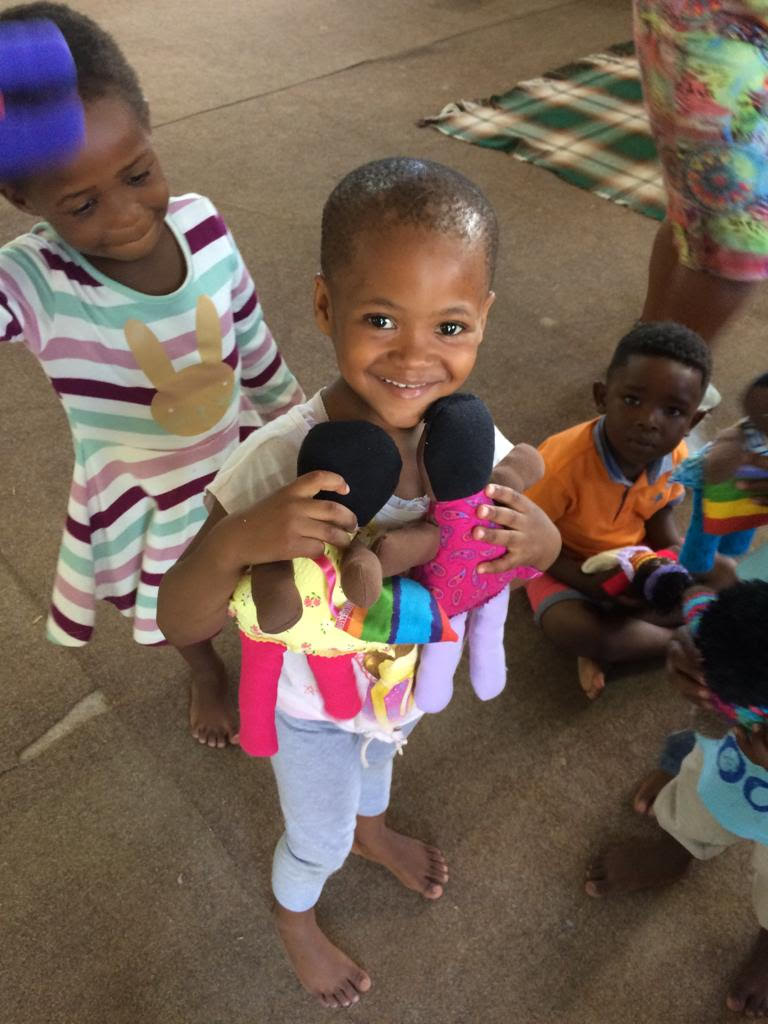
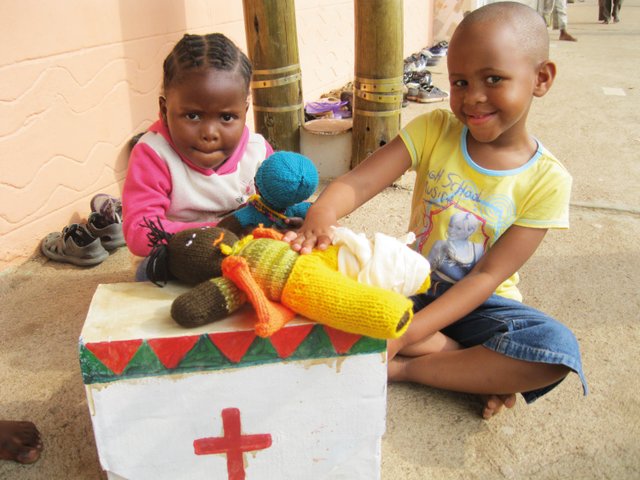
Zulu children in rural Kwa Zulu-Natal with their new knitted dolls

Photo; Tamsen Rochat receiving a box of dolls 2005

Throughout 2005 momentum increased, in Perth especially, through regular dollmaking days, doll garden parties, local media articles and an ABC TV programme illustrating the power of the project in a primary school. Dolls arrived from groups in Albany, Geraldton, Toodyay and Bunbury. Agnes Johnson reported from White Plains, New York of the enthusiasm there and that the dolls were being sent directly to Mtubatuba in KZN. By September 2005, Genge Hlabisa, our Zulu community volunteer, had distributed 2520 dolls in the Hlabisa district.


Photo; Dr Julie Stone and doll friends

2006 saw a huge leap in production to over 6000 dolls sent from Australia, hundreds from other countries and the spread of the project from Perth to Melbourne, Victoria. Over 100 requests for patterns resulted from an ABC radio interview with Dr Julie Stone, now living in Melbourne. Her international work inspired friends in London, Paris and USA to activate community groups. Over 20 schools participated in WA, with 15 community centres and hundreds of individuals.


Photo; A gathering of knitted dolls before sending them off to South Africa.

The invitation to make dolls was extended in many ways. In Western Australia, there was a Uthando Project stall at the Festival of Perth’s screening of “Yesterday” (a film which explored the life of an HIV+ Zulu woman, and her love for her child, Beauty). Doll kits were distributed at a market and an environmental fair. Uthando Project speakers invited dollmakers to get their needles busy at Seniors’ Centres, Social Groups, Rotary Clubs, many schools and community centres. The Soroptimists on the Terrace generously donated the income from the gallery Opening Night for the Western Dollmakers Exhibition. A regular dollmaking session was set up in Leederville and several workshops were held in Fremantle at Glyde –In Community Centre and The Meeting Place.


Georgia Efford and the first collection of dolls, Western Australia
Photo Echo Newspaper, Western Australia. Their newspaper article with this photo brought a huge response from doll makers.

Photo; Judy Mackintosh who has made many dolls seen here at one of the fundraising garden parties. Senior’s groups may contact Judy through email

Agnes Johnson in New York has arranged for hundreds of dolls to be sent. Dolls come from UK and Europe. They were simply posted to the Post Office in Mtubamtuba, although from Western Australia, 2 shipments were sent by sea of 1300 and 1800 dolls. See Contact Us for current postal address for the dolls.


Photo; Delighting in the different characters and saying goodbye as dolls are packed for shipment

INAUGURAL DOLL AUCTION


Photo; Deborah Mickle, who has taught many dollmakers in Fremantle, delivering bags of doll at the Garden party, Sept 05

The highlight of the year in Perth was the successful Doll Auction at the University of Western Australia. Over 50 artists and regular dollmakers donated amazingly creative dolls to be sold or auctioned, to raise funds to further the project.


Photo; Joy Whitfield who is the Communicator with Doll Makers.

 Such a major fundraising event now enables us to work in partnership with community networks in KwaZulu-Natal. The intention is to support the psycho-social cluster members of the CINDI (Children in Distress) Network, in programs that focus on fostering a deeper awareness of play. In October 2006, partnerships were established with such members. Key contacts are TREE (Training and Resources in Early Education), who operate from Durban, with centres throughout KZN; the Rob Smetherham Bereavement Services for Children in Pietermaritzburg, who work with training in grief therapy; and the Sizabantwana group of schools, linked with the Psychology Department of the University of KwaZulu-Natal. Setting up relationships with organisations that adhere to the CINDI principles of transparency, collaboration and sharing ensures that the dolls will find their right homes and that the funds will be applied wisely.


Photo; Judy Mackintosh in a typical dollmaking day, sewing one of many doll patterns so that others can fill and dress them.

Julie Stone and Uthando Project coordinator Georgia Efford participated in CINDI’s 10th Anniversary Conference in Pietermaritzburg in April 2006.  The conference reflected on lessons learned after 10 years of striving to improve the lives of children living midst the HIV and AIDS pandemic.  Many partnerships and plans were initiated during that visit.  These were consolidated when Dr Stone visited again in October, accompanied by Irene Gill and Clare Harris. It becomes clearer and clearer to us, how deep and wide and exhausting is the work of hundreds of courageous volunteer organisations and government departments committed to combating the profound effects of HIV / AIDS, poverty and malnutrition upon children and families in South Africa. The challenge before them is of a greater magnitude than the world has ever faced, and all indications are that the pandemic has not yet reached its peak.  2 million women in Southern Africa are HIV positive.  Most of them are mothers.  In KZN, more than 40% of women attending ante natal clinics are found to have the infection. Uthando Project seeks to support organisations already showing experienced commitment to the holistic health of children and their carers.


Photo; Brian Harffey with his prototype of animal/person doll. We call it Smart Cat. This Cat has traveled to a conference in Paris as our ambassador.

Media coverage has also helped the project, with many articles in local and national media. These articles speak on behalf of the Zulu children and often introduce us to new dollmakers.

The Uthando Project was honoured to receive the Group Award by the Western Australian AIDS Council for their annual World AIDS Day (Dec 1st) celebrations,

Meanwhile in New York, Agnes Johnson has generated great action and awareness of the project and its intentions with the support of the Youth Bureau for the City of White Plains, NY, Edward Williams Elementary School in Mt Vernon, NY, Sister’s Uptown Bookstore in Harlem, Cedar Knolls School for Boys and Girls in Hawthorne, Manhattan Pentecostal Church, NY Phelam Art Center, the Cities of Yonkers and New Rochelle, African Folk Heritage Circle in NY and WESPAC in Westchester,NY.

After presenting a poster about Uthando’s work to the World Association of Infant Mental Health Meeting in Paris, July 2006, Dr Julie Stone was invited to speak to the Unitarian Chapel community in Hampstead, London. A creative and enthusiastic group of doll makers, led by Claire Julian, has been busy making dolls since then.  And the chapel community network is inspiring other groups to become involved.

If we take a long look at the Uthando Project, and how it has grown, we can all be proud, because anyone can contribute to this grass roots movement. In fact thousands have done so. It is so simple. People everywhere can make dolls using the basic patterns offered by Uthando volunteers, or their own patterns, and send the dolls directly to TREE in Durban.

Because we are a grassroots project, it is open to anyone with likeminded intentions to take on leadership and contribute by spreading the work of the project through their own networks.

There is a core group of volunteersin Perth who check the Western Australian dolls for suitability, design and roadtest new patterns, do the packing, handle enquiries, visit schools and community groups, instigate and encourage new dollmaking groups and raise funds. All running costs (including travel to KZN) are covered by the individuals concerned.

Play begins with the making of the dolls. Love is embedded in these handmade dolls, which carry with them the warm intention of the best possible outcomes for the child.

We distribute, by email and post, newsletters that give detailed accounts of visits to KZN and other dollmaking news. Please request any newsletters by email to Joy Whitfield, communicator or register for our newletters by filling in the form on the left of this page.